Dr. Jazayeri treats knee cartilage defects in Los Angeles, damaged patches of the smooth surface that cushions the joint. Care starts with physical therapy, activity changes, and weight management. For select defects in an otherwise healthy knee, Dr. Jazayeri discusses cartilage restoration to rebuild the surface.
Reza Jazayeri diagnoses and treats knee cartilage defect in Los Angeles, from the first visit through recovery.
What is Cartilage Defect?
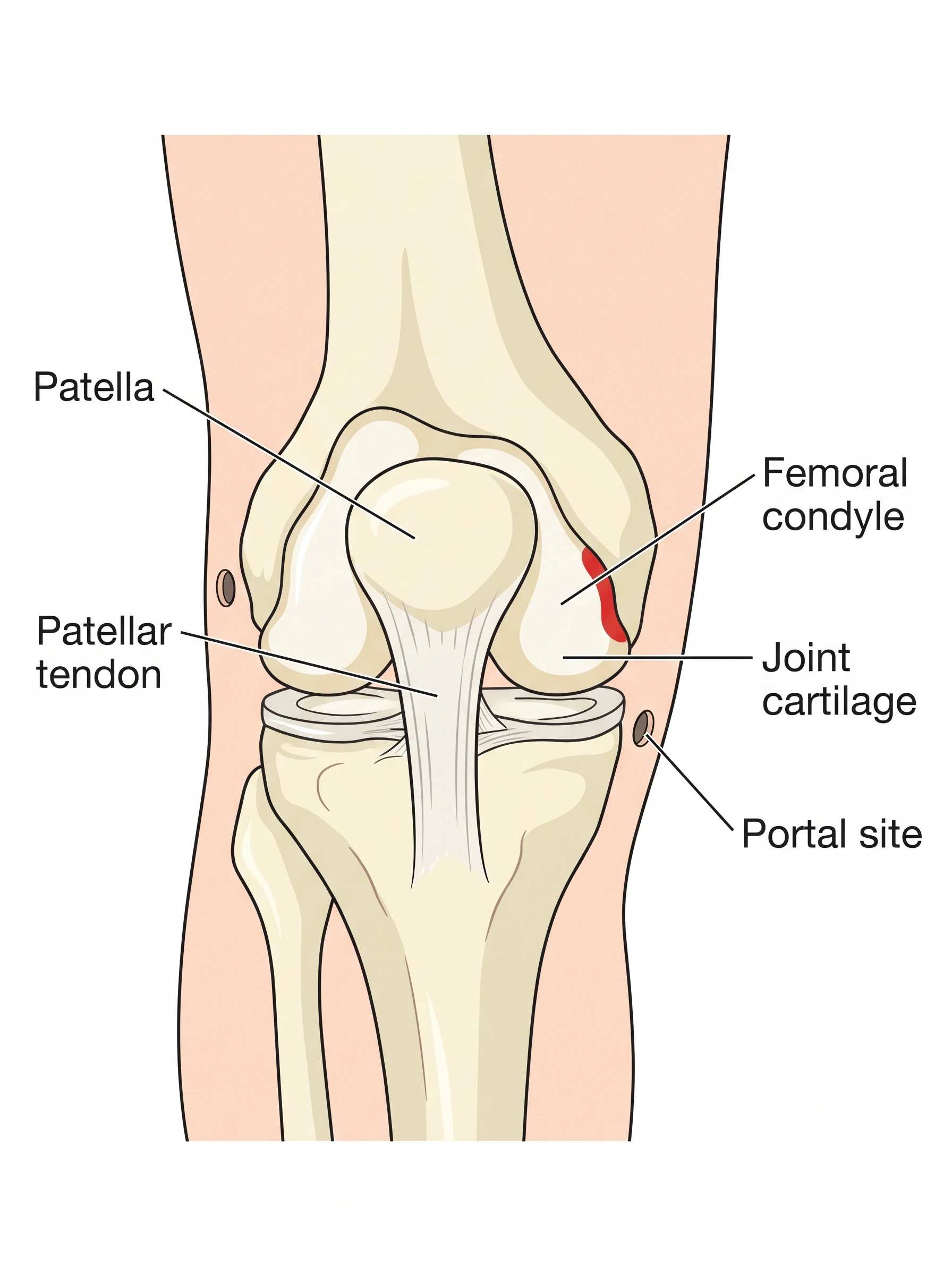
A cartilage defect is a damaged area of the smooth tissue, called articular cartilage, that lets the knee bones glide against each other.
Unlike widespread arthritis, a defect is often a focused patch of damage.
Defects can come from an injury, such as a twist or a kneecap dislocation, or from wear over time. Symptoms include pain with activity, swelling, and sometimes catching if a loose piece is present.
Cartilage has little blood supply, so it does not heal well on its own. Whether a defect can be restored depends on its size, its location, and the health of the surrounding cartilage.
How is Cartilage Defect diagnosed, and what does the visit involve?
Dr. Jazayeri reviews your injury history and examines the knee for tenderness, swelling, and catching.
X-rays check the joint and rule out arthritis. An MRI scan, which shows cartilage in detail, maps the size and depth of the defect and guides whether restoration is an option.
What is recovery like for Cartilage Defect?
Small defects may be managed with non-surgical care.
Larger defects in an otherwise healthy knee may be candidates for restoration, which aims to rebuild a durable surface. These procedures often involve a staged rehabilitation, and Dr. Jazayeri will explain which technique fits your defect and what recovery involves.
What are the treatment options?
- 01Activity changes and weight management to reduce load on the defectActivity changes and weight management to reduce load on the defect.
- 02Physical therapy to support the joint and improve mechanicsPhysical therapy to support the joint and improve mechanics.
- 03Anti-inflammatory medicine or an injection to control symptoms when appropriateAnti-inflammatory medicine or an injection to control symptoms when appropriate.
- 04Arthroscopic assessment, a small camera through tiny incisions, to size and grade the defeArthroscopic assessment, a small camera through tiny incisions, to size and grade the defect.
- 05Cartilage restoration procedures for suitable defects, chosen based on size and locationCartilage restoration procedures for suitable defects, chosen based on size and location.
Education and training
Medical school at Albert Einstein College of Medicine. Residency at NYU Hospital for Joint Diseases. Fellowship at Kerlan-Jobe Orthopaedic Clinic.
- FellowshipKerlan-Jobe Orthopaedic ClinicSports medicine
- ResidencyNYU Hospital for Joint DiseasesOrthopedic surgery residency
- Medical schoolAlbert Einstein College of MedicineDoctor of Medicine
- Board statusAmerican Board of Orthopaedic SurgeryBoard certified
What do patients ask most?
Is a cartilage defect the same as arthritis?+
Can knee cartilage grow back?+
Who is a candidate for cartilage restoration?+
What happens if a cartilage defect is left alone?+
DOCS Health
DOCS Satellite Westlake
696 Hampshire Rd
Suite 100 / Suite 180, Westlake Village, CA 91361
Phone(844) 529-0911
Fellowship trained at Kerlan-Jobe Orthopaedic Clinic (Sports medicine). Sees patients in Los Angeles.
About Dr. Jazayeri →