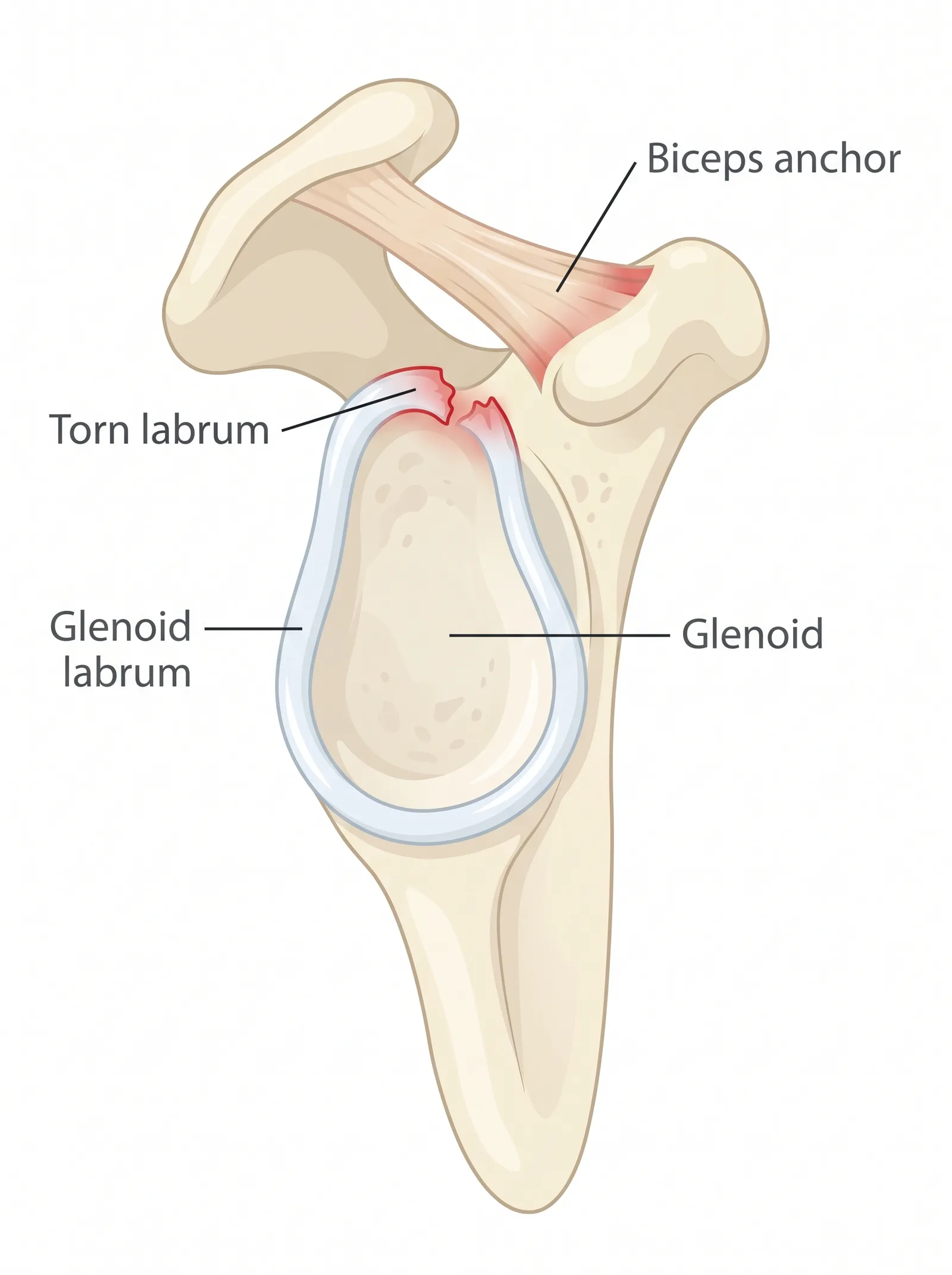
Labral repair reattaches a torn labrum, the ring of cartilage that deepens the shoulder socket. Dr. Jazayeri performs it for people with a SLAP or labral tear causing pain, catching, or a loss of shoulder strength. Most people rebuild the shoulder over several months with therapy.
Reza Jazayeri performs shoulder labral repair in Los Angeles when it is the right step, and reviews every alternative with you first.
What is a labral repair, and who is it for?
The labrum is a rim of cartilage around the shoulder socket that helps hold the ball in place and anchors the biceps tendon.
A tear, often at the top of the socket (a SLAP tear) from a fall, a throwing motion, or repeated overhead use, can cause deep shoulder pain, catching, and weakness. Labral repair is for tears that keep causing symptoms after rest and therapy.
What is tried before surgery?
Most labral tears start with nonsurgical care: activity changes, anti-inflammatory measures, and physical therapy for the rotator cuff and shoulder-blade muscles.
Surgery becomes the right conversation when pain, catching, or instability continue despite this care, or when the tear is part of a larger shoulder injury.
How does labral repair work?
The surgeon repairs the torn labrum using arthroscopy, a small camera through tiny incisions, reattaching it to the rim of the socket so the shoulder is stable again.
What is repaired depends on the tear pattern, which is confirmed during the procedure.
What is recovery like?
The shoulder is protected in a sling early, then motion and strength are rebuilt through months of physical therapy.
Return to sport, especially overhead and throwing sports, is commonly reported over several months and depends on the tear and your progress, according to general guidance from the American Academy of Orthopaedic Surgeons. These are ranges, not promises.
Read the full guide to preparing for surgery →
Your own recovery instructions come from the office and are specific to you. This page describes the general course, not a plan to follow.
Education and training
Medical school at Albert Einstein College of Medicine. Residency at NYU Hospital for Joint Diseases. Fellowship at Kerlan-Jobe Orthopaedic Clinic.
- FellowshipKerlan-Jobe Orthopaedic ClinicSports medicine
- ResidencyNYU Hospital for Joint DiseasesOrthopedic surgery residency
- Medical schoolAlbert Einstein College of MedicineDoctor of Medicine
- Board statusAmerican Board of Orthopaedic SurgeryBoard certified
What do patients ask most?
Do all labral tears need surgery?+
How long is recovery?+
Is it done with a camera?+
DOCS Health
DOCS Satellite Westlake
696 Hampshire Rd
Suite 100 / Suite 180, Westlake Village, CA 91361
Phone(844) 529-0911
Fellowship trained at Kerlan-Jobe Orthopaedic Clinic (Sports medicine). Sees patients in Los Angeles.
About Dr. Jazayeri →