What is AC Joint Reconstruction, and who is it for?
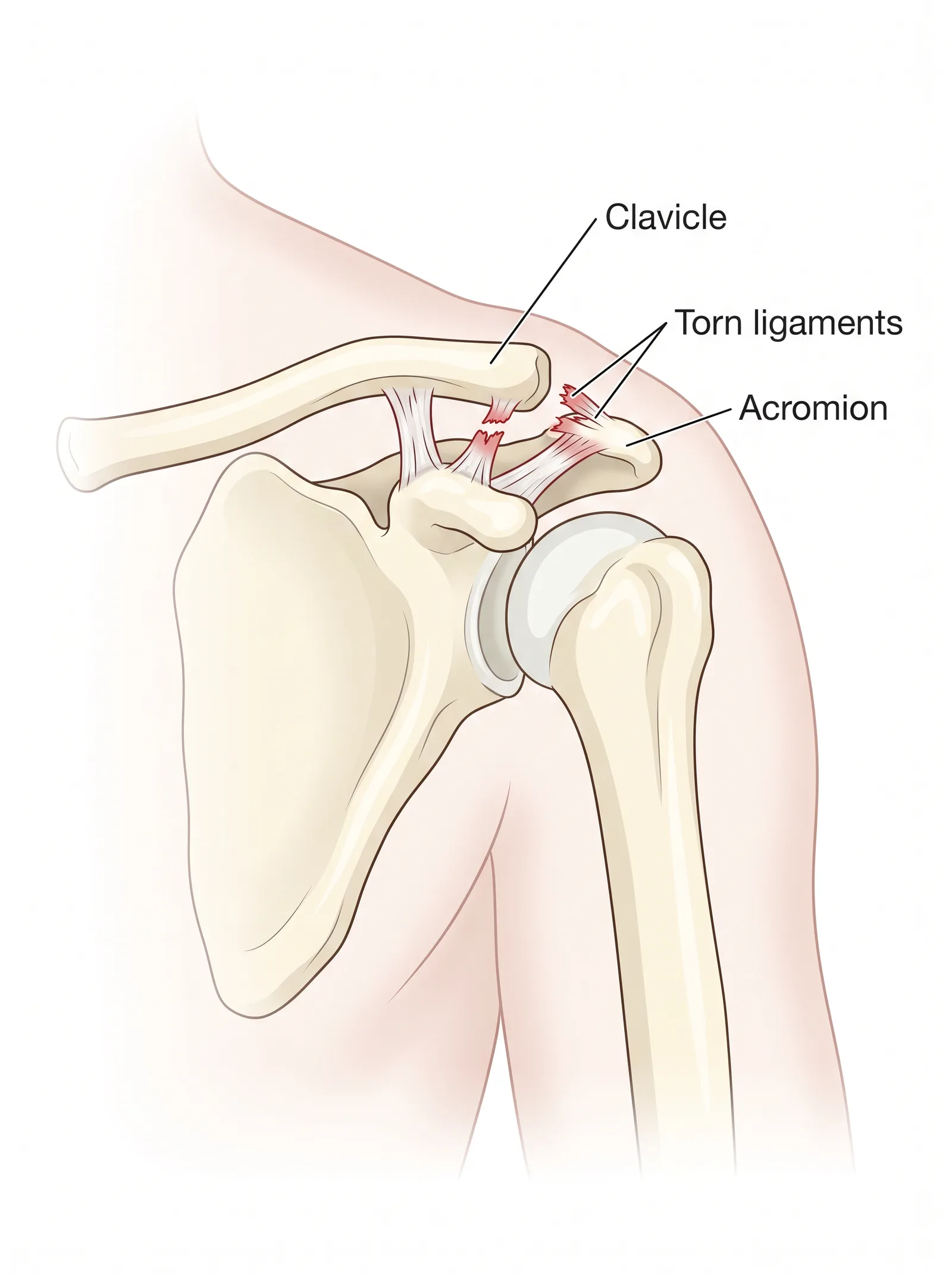
The AC joint is the small joint at the top of the shoulder where the end of the collarbone, called the clavicle, meets a part of the shoulder blade called the acromion.
AC stands for acromioclavicular, the two bones that meet there. Strong ligaments, which are the bands that connect bone to bone, hold the collarbone in its correct position. When these ligaments tear, usually from a fall directly onto the top of the shoulder, the collarbone can lift away from the shoulder blade. This injury is called an AC joint separation, or a separated shoulder. It is different from a dislocated shoulder, which involves the ball-and-socket joint below.
The severity of a separation depends on how many ligaments are torn and how far the collarbone has shifted. Milder separations often heal without surgery. More severe ones, where the collarbone is clearly displaced, may need surgery to restore the joint.
AC joint reconstruction is surgery that rebuilds the torn ligaments so the collarbone is held back down in the correct position. The surgeon uses strong sutures and often a graft, which is a piece of tendon tissue, to recreate the ligaments that were lost. The word reconstruction means rebuilding the ligaments, as opposed to simply repairing them, and it is typically used for higher-grade or longer-standing separations.
This procedure is considered for people with a severe or persistent AC joint separation that causes pain, weakness, a visible bump at the top of the shoulder, or difficulty with overhead and heavy activity. Dr. Jazayeri will explain whether your separation is one that benefits from surgery or one better managed without it.
What are the symptoms of AC Joint Reconstruction, and when should you see a specialist?
People with an AC joint separation often describe.
- Pain right at the top of the shoulder, over the joint, after a fall or a direct blow. - A visible bump or step at the top of the shoulder where the collarbone sticks up. - Pain when reaching across the body or lifting overhead. - Weakness or a sense that the shoulder cannot handle pushing or pressing. - Aching that lingers over the joint with activity, sometimes long after the injury.
Most separations happen from a specific event, like a fall from a bike or a hit in sport. A visible bump with pain after such an injury is worth having evaluated. It is reasonable to see a specialist when the pain and bump do not improve over several weeks, when a severe deformity is present from the start, or when shoulder weakness limits work or sport. This section describes symptoms to help you decide whether to be evaluated; it is not a diagnosis, and the grade of a separation is determined by exam and imaging.
How is AC Joint Reconstruction diagnosed, and what does the visit involve?
History. Dr. Jazayeri asks how the injury happened, where the pain is, whether a bump appeared, and how the shoulder now functions.
A fall onto the top of the shoulder with a bump is a classic pattern.
Exam. The surgeon looks at the shape of the shoulder, compares it to the other side, and gently presses over the AC joint. Specific movements, like reaching the arm across the body, load the joint and often reproduce the pain. The exam grades how unstable the joint is.
Imaging. X-rays are central and show how far the collarbone has shifted relative to the shoulder blade, which determines the grade of the separation. Sometimes X-rays are taken while holding a weight, or comparing both shoulders, to show the displacement clearly. An MRI, a scan that shows soft tissue, may be added to assess the ligaments and check for other injuries. The grade guides the decision, so imaging is essential.
What happens during AC Joint Reconstruction, step by step?
AC joint reconstruction can be done arthroscopically, with a camera and small incisions, or through an open incision, and often a combination.
Here is the general sequence.
Anesthesia. You receive anesthesia so you feel no pain, usually a general anesthetic often combined with a nerve block, which numbs the shoulder for pain control afterward.
Positioning. You are placed partly upright, and the shoulder is prepared and draped.
Exposure and inspection. The surgeon reaches the AC joint and the top of the collarbone. If a camera is used, the joint below can be inspected for any additional injury.
Restoring the position. The collarbone is brought back down into its correct alignment with the shoulder blade.
Rebuilding the ligaments. The surgeon secures the collarbone in position using strong sutures, often passed through small tunnels or around the nearby bone, and frequently reinforces the repair with a graft, which is a piece of tendon that recreates the torn ligaments. The graft may come from a tissue bank or, in some cases, from your own body. The combination holds the collarbone down while the tissue heals.
Checking and closing. The surgeon confirms the alignment and stability, then closes the incisions. The arm is placed in a sling.
AC joint reconstruction is often an outpatient procedure, meaning you go home the same day. The exact technique varies by surgeon and by how long ago the injury happened, since older injuries usually require a graft reconstruction rather than a simple repair.
What is the recovery timeline for AC Joint Reconstruction?
Recovery is guided by milestones, meaning what the shoulder can do, alongside typical calendar ranges from the American Academy of Orthopaedic Surgeons.
These are ranges, not promises. Because the reconstruction must hold the collarbone down while ligaments heal, early protection is especially important.
Phase 1, protection (about weeks 0 to 6). The sling protects the reconstruction and keeps weight off the healing ligaments. Gentle hand, wrist, and elbow motion is usually allowed, but the arm is kept from bearing weight or reaching far, which would pull on the repair. The milestone is protecting the alignment while tissue heals.
Phase 2, restoring motion (about weeks 6 to 12). With clearance, the sling comes off and therapy restores shoulder motion in stages. The milestone is smooth, controlled range of motion without stressing the reconstruction. Overhead reaching is added gradually.
Phase 3, strengthening (about months 3 to 4 onward). As the ligaments heal, therapy adds strengthening for the shoulder and shoulder blade. The milestone is regaining strength for pushing, pressing, and lifting.
Phase 4, return to activity (about months 4 to 6 and beyond). Return to contact sport or heavy overhead and lifting work is the final milestone, based on strength, motion, and confidence. According to general AAOS guidance, return to demanding activity commonly falls in the four-to-six-month range and sometimes longer. The criterion is readiness, not a fixed date.
Read the full guide to preparing for surgery →
Your own recovery instructions come from the office and are specific to you. This page describes the general course, not a plan to follow.
How should you prepare for surgery?
At home. Arrange a place to rest partly upright, such as a recliner or wedge pillow.
Keep daily items within reach of your non-surgical arm. Button-front or zip clothing is easier than pullovers.
Transportation. You cannot drive after anesthesia, and you should not drive while in the sling or taking pain medication, often for a few weeks. Arrange rides in advance.
Time off. Desk work is often possible within one to two weeks, sometimes with the arm in a sling. Lifting, pushing, or overhead work takes longer and needs a specific plan. Ask your surgeon what your job requires.
Help on hand. Have someone available for the first day or two for meals, dressing, and settling in.
Before the date. Follow the eating-and-drinking instructions before anesthesia. Report all medications and supplements, since some, including blood thinners, may need to be paused. If you smoke, ask about stopping, because it can affect ligament and tissue healing.
Which warning signs should you call about?
Call the surgical office if you notice the following.
- A fever over 101 degrees Fahrenheit, or chills. - Increasing redness, warmth, or drainage from the incision, especially cloudy or foul-smelling fluid. - Pain that keeps worsening rather than slowly easing, or pain not controlled by your medication. - A new or returning bump at the top of the shoulder with increased pain, which can mean the reconstruction is under strain and should be evaluated. - New numbness, tingling, or weakness in the hand or arm that does not resolve with repositioning.
Get emergency care immediately for chest pain, trouble breathing, or a calf that becomes swollen, red, and painful, which can signal a blood clot.
During business hours, call the office of Reza Jazayeri at (844) 529-0911. Office hours are . For urgent problems after hours, follow your surgical team's after-hours instructions, or go to the nearest emergency department.
What results can you expect from AC Joint Reconstruction?
AC joint reconstruction has a good record for restoring the position of the collarbone and relieving pain from higher-grade separations.
Consistent with general guidance from the American Academy of Orthopaedic Surgeons and the orthopedic literature, most patients report good pain relief and return of function after reconstruction of a severe AC joint separation, and the majority return to their prior activities including sport. Some loss of the corrected position over time, meaning a partial return of the bump, is reported across a range of cases, which is one reason surgery is reserved for separations that genuinely warrant it rather than for a bump alone. These are ranges reported across studies and populations, not promises about any single shoulder.
The practical point is that reconstruction is well suited to displaced, symptomatic separations, and that milder ones usually do well without surgery. Dr. Jazayeri will explain which category your injury falls into, using your own imaging.
What are the treatment options?
- 01Sling and restA sling supports the arm and lets the pain settle in the early weeks. Lower-grade separations often heal well this way, even though a small bump may remain.
- 02Physical therapyOnce pain eases, guided exercises restore motion and strength in the shoulder and shoulder blade. Many people regain full function without surgery.
- 03Activity change and timeAvoiding heavy lifting and contact while healing allows the joint to settle. For a visible bump without ongoing pain or weakness, no further treatment may be needed, since the bump itself is often cosmetic.
- 04Pain measuresOver-the-counter anti-inflammatory medication, used as directed, can help early pain. Your physician will advise whether it is appropriate.
What do patients ask most?
What do patients ask about AC Joint Reconstruction?+
Education and training
Medical school at Albert Einstein College of Medicine. Residency at NYU Hospital for Joint Diseases. Fellowship at Kerlan-Jobe Orthopaedic Clinic.
- FellowshipKerlan-Jobe Orthopaedic ClinicSports medicine
- ResidencyNYU Hospital for Joint DiseasesOrthopedic surgery residency
- Medical schoolAlbert Einstein College of MedicineDoctor of Medicine
- Board statusAmerican Board of Orthopaedic SurgeryBoard certified
DOCS Health
DOCS Satellite Westlake
696 Hampshire Rd
Suite 100 / Suite 180, Westlake Village, CA 91361
Phone(844) 529-0911